From Theory to Production
Building an Enterprise-Grade AI Testing Framework
Robert Cunningham (via Artium AI)
AI Engineer & Consultant
Building a Testing Framework: From Theory to Production
12 min read
In the previous posts, we explored the theoretical foundations of agentic reliability. Now let's dive into the actual implementation—transforming mathematical elegance into production-ready testing systems.
The Challenge: Testing the Untestable
Picture your QA engineer's face when you tell them to test an AI agent that can:
- Dynamically choose from 50+ tools
- Recursively invoke other agents
- Generate novel solutions to problems
- Adapt its strategy based on intermediate results
Traditional test frameworks weren't built for this. New approaches were needed from scratch.
Architecture Overview: The Three Pillars
Our testing framework rests on three foundational pillars:
┌─────────────────────────────────────────────┐
│           RELIABILITY TESTING FRAMEWORK      │
├───────────────┬──────────────┬───────────────┤
│   Scenario    │   Execution   │   Analysis    │
│   Generation  │   Engine      │   Pipeline    │
├───────────────┼──────────────┼───────────────┤
│ • Parametric  │ • Parallel    │ • Statistical │
│ • Adaptive    │ • Isolated    │ • Temporal    │
│ • Coverage    │ • Observable  │ • Predictive  │
└───────────────┴──────────────┴───────────────┘
Let's build each component from the ground up.
Pillar 1: Intelligent Scenario Generation
The Parametric Test Factory
Instead of writing individual tests, we define test generators:
from typing import List, Dict, Any
from dataclasses import dataclass
import itertools

@dataclass
class TestScenario:
    input: str
    context: Dict[str, Any]
    expected_behavior: str
    constraints: List[str]

class ScenarioGenerator:
    def __init__(self, agent_config: AgentConfig):
        self.agent = agent_config
        self.tool_combinations = self._generate_tool_combinations()

    def _generate_tool_combinations(self):
        """Generate all meaningful tool combination sequences"""
        tools = self.agent.available_tools
        combinations = []

        # Single tool invocations
        for tool in tools:
            combinations.append([tool])

        # Paired tool sequences (order matters)
        for t1, t2 in itertools.permutations(tools, 2):
            if self._is_valid_sequence(t1, t2):
                combinations.append([t1, t2])

        # Triple sequences with constraints
        for combo in itertools.permutations(tools, 3):
            if self._is_valid_sequence(*combo):
                combinations.append(list(combo))

        return combinations

    def generate_scenarios(self,
                         base_prompts: List[str],
                         complexity_levels: List[int]) -> List[TestScenario]:
        """Generate test scenarios across multiple dimensions"""
        scenarios = []

        for prompt in base_prompts:
            for complexity in complexity_levels:
                for tool_combo in self.tool_combinations[:complexity]:
                    scenario = self._create_scenario(
                        prompt, tool_combo, complexity
                    )
                    scenarios.append(scenario)

        return scenarios
Adaptive Test Selection
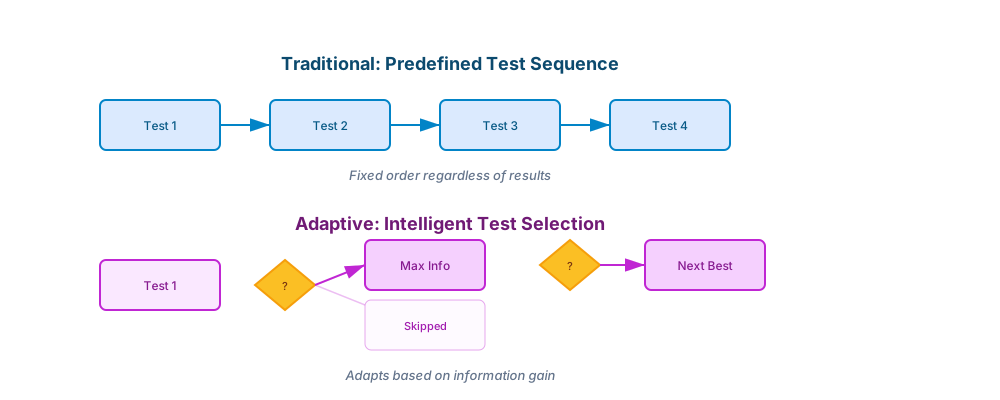
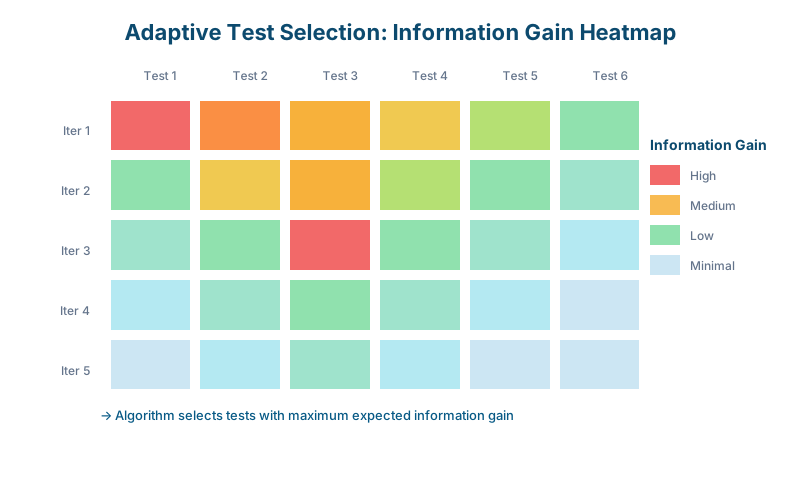
Not all test scenarios are equally valuable. We use information theory to select the most informative tests:
import numpy as np
from scipy.stats import entropy

class AdaptiveTestSelector:
    def __init__(self, history: TestHistory):
        self.history = history
        self.belief_state = self._initialize_beliefs()

    def select_next_test(self,
                        candidates: List[TestScenario]) -> TestScenario:
        """Select test that maximizes expected information gain"""

        information_gains = []
        for scenario in candidates:
            # Calculate expected reduction in uncertainty
            gain = self._calculate_information_gain(scenario)
            information_gains.append(gain)

        # Select scenario with maximum gain
        best_idx = np.argmax(information_gains)
        return candidates[best_idx]

    def _calculate_information_gain(self, scenario: TestScenario) -> float:
        """Calculate expected information gain from a test"""

        # Current entropy of belief state
        current_entropy = entropy(self.belief_state)

        # Expected posterior entropy after test
        expected_posterior = 0.0
        for outcome in self._possible_outcomes(scenario):
            prob_outcome = self._outcome_probability(outcome, scenario)
            posterior = self._update_beliefs(outcome, scenario)
            expected_posterior += prob_outcome * entropy(posterior)

        return current_entropy - expected_posterior
Pillar 2: The Execution Engine
Isolated Execution Environments
Each test runs in a completely isolated environment to ensure reproducibility:
from contextlib import contextmanager
import docker
import asyncio

class IsolatedExecutor:
    def __init__(self, base_image: str = "artium/agent-test:latest"):
        self.docker_client = docker.from_env()
        self.base_image = base_image

    @contextmanager
    def isolated_environment(self, scenario: TestScenario):
        """Create isolated execution environment for test"""

        # Create container with exact dependencies
        container = self.docker_client.containers.run(
            self.base_image,
            detach=True,
            environment={
                "TEST_ID": scenario.id,
                "AGENT_CONFIG": scenario.agent_config_json,
            },
            volumes={
                '/tmp/test-artifacts': {'bind': '/artifacts', 'mode': 'rw'}
            }
        )

        try:
            # Initialize agent in container
            self._initialize_agent(container, scenario)

            # Set up monitoring
            monitor = self._attach_monitor(container)

            yield container, monitor

        finally:
            # Collect artifacts
            self._collect_artifacts(container)

            # Clean up
            container.stop()
            container.remove()

    async def execute_scenario(self, scenario: TestScenario) -> TestResult:
        """Execute test scenario in isolated environment"""

        with self.isolated_environment(scenario) as (container, monitor):
            # Start execution
            execution_task = asyncio.create_task(
                self._run_agent(container, scenario)
            )

            # Monitor execution
            monitoring_task = asyncio.create_task(
                monitor.collect_metrics()
            )

            # Wait for completion with timeout
            try:
                result = await asyncio.wait_for(
                    execution_task,
                    timeout=scenario.timeout
                )
            except asyncio.TimeoutError:
                result = TestResult(status="timeout", scenario=scenario)

            # Get monitoring data
            metrics = await monitoring_task
            result.metrics = metrics

            return result
Parallel Execution at Scale
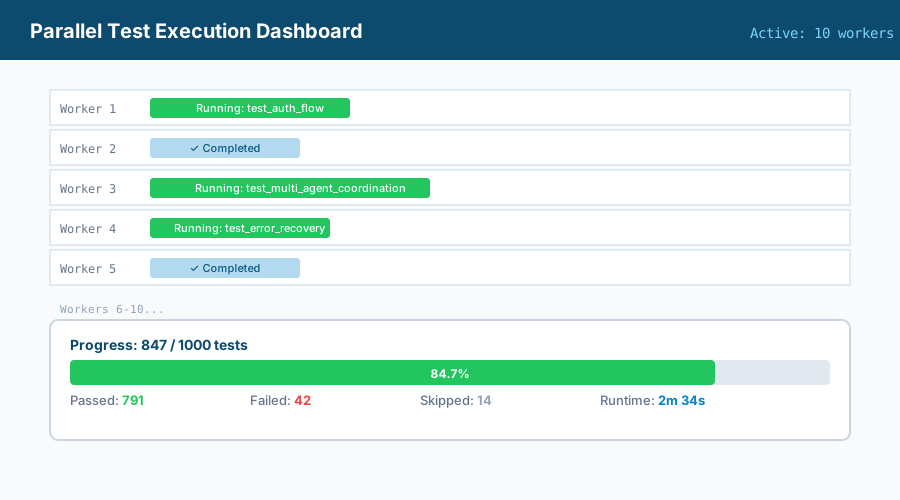
Running thousands of tests sequentially would take forever. Here's our parallel execution orchestrator:
from concurrent.futures import ThreadPoolExecutor, as_completed
import ray

@ray.remote
class DistributedTestRunner:
    def __init__(self, executor_config: Dict):
        self.executor = IsolatedExecutor(**executor_config)

    async def run_test(self, scenario: TestScenario) -> TestResult:
        return await self.executor.execute_scenario(scenario)

class ParallelOrchestrator:
    def __init__(self, num_workers: int = 10):
        ray.init(num_cpus=num_workers)
        self.runners = [
            DistributedTestRunner.remote({})
            for _ in range(num_workers)
        ]

    async def execute_test_suite(self,
                                scenarios: List[TestScenario]) -> List[TestResult]:
        """Execute test suite in parallel"""

        # Distribute scenarios across workers
        futures = []
        for i, scenario in enumerate(scenarios):
            runner = self.runners[i % len(self.runners)]
            future = runner.run_test.remote(scenario)
            futures.append(future)

        # Collect results as they complete
        results = []
        for future in ray.get(futures):
            results.append(future)

            # Real-time analysis
            self._analyze_intermediate_results(results)

        return results
Pillar 3: The Analysis Pipeline
Statistical Reliability Metrics
Raw pass/fail rates don't tell the whole story. We need sophisticated metrics:
from scipy import stats
import pandas as pd

class ReliabilityAnalyzer:
    def __init__(self, results: List[TestResult]):
        self.results = results
        self.df = self._results_to_dataframe(results)

    def calculate_reliability_score(self) -> Dict[str, float]:
        """Calculate comprehensive reliability metrics"""

        metrics = {}

        # Basic success rate
        metrics['success_rate'] = self.df['success'].mean()

        # Confidence interval (Wilson score interval)
        successes = self.df['success'].sum()
        n = len(self.df)
        metrics['ci_lower'], metrics['ci_upper'] = self._wilson_score_interval(
            successes, n, alpha=0.05
        )

        # Consistency score (lower variance is better)
        grouped = self.df.groupby('scenario_type')['success'].agg(['mean', 'std'])
        metrics['consistency_score'] = 1 / (1 + grouped['std'].mean())

        # Recovery rate (success after initial failure)
        recovery_sequences = self._identify_recovery_sequences()
        metrics['recovery_rate'] = len(recovery_sequences) / max(1, self._count_failures())

        # Degradation resistance (performance under load)
        metrics['degradation_coefficient'] = self._calculate_degradation()

        return metrics

    def _wilson_score_interval(self, successes: int, n: int, alpha: float = 0.05):
        """Calculate Wilson score confidence interval"""

        z = stats.norm.ppf(1 - alpha/2)
        p_hat = successes / n

        denominator = 1 + z**2 / n
        center = (p_hat + z**2 / (2*n)) / denominator
        margin = z * np.sqrt(p_hat * (1-p_hat) / n + z**2 / (4*n**2)) / denominator

        return center - margin, center + margin
Temporal Pattern Analysis
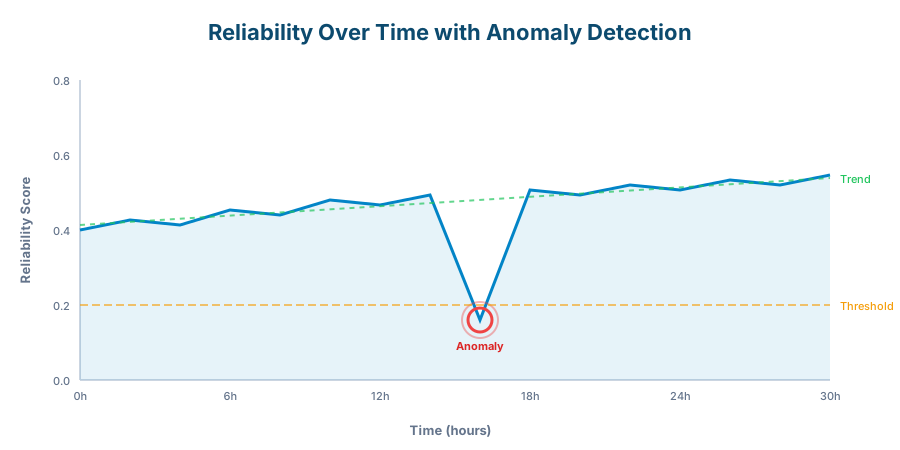
Reliability isn't static—it evolves over time. We track temporal patterns:
from statsmodels.tsa.seasonal import seasonal_decompose
import numpy as np

class TemporalAnalyzer:
    def __init__(self, time_series_data: pd.DataFrame):
        self.data = time_series_data

    def detect_reliability_trends(self) -> Dict:
        """Detect trends in reliability over time"""

        # Decompose time series
        decomposition = seasonal_decompose(
            self.data['reliability_score'],
            model='additive',
            period=24  # Assuming hourly data with daily patterns
        )

        analysis = {
            'trend': decomposition.trend,
            'seasonal': decomposition.seasonal,
            'residual': decomposition.resid
        }

        # Detect anomalies
        residual_std = decomposition.resid.std()
        analysis['anomalies'] = self.data[
            abs(decomposition.resid) > 3 * residual_std
        ]

        # Predict future reliability
        analysis['forecast'] = self._forecast_reliability()

        return analysis

    def _forecast_reliability(self, horizon: int = 24):
        """Forecast future reliability using ARIMA"""

        from statsmodels.tsa.arima.model import ARIMA

        model = ARIMA(self.data['reliability_score'], order=(2,1,2))
        fitted = model.fit()

        forecast = fitted.forecast(steps=horizon)
        return forecast
Real-World Integration: The Complete Pipeline
Here's how all components work together in production:
class ProductionTestingPipeline:
    def __init__(self, config: PipelineConfig):
        self.generator = ScenarioGenerator(config.agent_config)
        self.selector = AdaptiveTestSelector(config.test_history)
        self.orchestrator = ParallelOrchestrator(config.num_workers)
        self.analyzer = ReliabilityAnalyzer([])

    async def run_comprehensive_test(self,
                                    test_budget: int = 1000) -> TestReport:
        """Run comprehensive reliability test within budget"""

        # Phase 1: Exploratory testing
        print("Phase 1: Exploratory Testing")
        base_scenarios = self.generator.generate_scenarios(
            base_prompts=self._get_base_prompts(),
            complexity_levels=[1, 2, 3]
        )

        initial_results = await self.orchestrator.execute_test_suite(
            base_scenarios[:test_budget // 3]
        )

        # Phase 2: Adaptive focused testing
        print("Phase 2: Adaptive Testing")
        self.analyzer.results.extend(initial_results)
        weak_areas = self._identify_weak_areas(initial_results)

        focused_scenarios = []
        remaining_budget = test_budget - len(initial_results)

        for _ in range(remaining_budget // 3):
            next_test = self.selector.select_next_test(
                self._generate_focused_candidates(weak_areas)
            )
            focused_scenarios.append(next_test)

        focused_results = await self.orchestrator.execute_test_suite(
            focused_scenarios
        )

        # Phase 3: Stress testing
        print("Phase 3: Stress Testing")
        stress_scenarios = self._generate_stress_tests(
            num_tests=test_budget - len(self.analyzer.results)
        )

        stress_results = await self.orchestrator.execute_test_suite(
            stress_scenarios
        )

        # Comprehensive analysis
        all_results = initial_results + focused_results + stress_results
        return self._generate_report(all_results)
The Secret Sauce: Observability and Debugging
Comprehensive Trace Collection
Every test execution generates detailed traces:
class TraceCollector:
    def __init__(self, trace_store: TraceStore):
        self.store = trace_store

    def instrument_agent(self, agent: Agent) -> Agent:
        """Add comprehensive instrumentation to agent"""

        original_execute = agent.execute

        def traced_execute(input: str, context: Dict) -> str:
            trace_id = self.store.start_trace()

            # Record input
            self.store.add_event(trace_id, 'input', {
                'text': input,
                'context': context,
                'timestamp': time.time()
            })

            # Hook into tool calls
            for tool in agent.tools:
                self._instrument_tool(tool, trace_id)

            try:
                # Execute with monitoring
                with self._monitor_execution(trace_id):
                    result = original_execute(input, context)

                # Record output
                self.store.add_event(trace_id, 'output', {
                    'text': result,
                    'timestamp': time.time()
                })

                return result

            except Exception as e:
                self.store.add_event(trace_id, 'error', {
                    'exception': str(e),
                    'traceback': traceback.format_exc()
                })
                raise

            finally:
                self.store.finalize_trace(trace_id)

        agent.execute = traced_execute
        return agent
Visual Debugging Interface
We built a custom visualization tool for understanding complex agent behaviors:

class VisualDebugger:
    def __init__(self, trace_data: TraceData):
        self.trace = trace_data

    def generate_decision_graph(self) -> str:
        """Generate Graphviz representation of decision flow"""

        dot = graphviz.Digraph(comment='Agent Decision Flow')

        # Add nodes for each decision point
        for event in self.trace.events:
            if event.type == 'tool_selection':
                dot.node(event.id,
                        f"Tool: {event.tool_name}\nConfidence: {event.confidence:.2f}")

        # Add edges showing flow
        for i, event in enumerate(self.trace.events[:-1]):
            next_event = self.trace.events[i + 1]
            dot.edge(event.id, next_event.id,
                    label=f"{event.duration_ms}ms")

        return dot.render(format='svg')
Performance Optimizations: Making It Fast
Smart Caching
Not all test scenarios are unique. We cache intelligently:
class SmartTestCache:
    def __init__(self, redis_client):
        self.redis = redis_client
        self.cache_hits = 0
        self.cache_misses = 0

    def get_or_execute(self,
                       scenario: TestScenario,
                       executor: Callable) -> TestResult:
        """Execute test or return cached result if valid"""

        cache_key = self._generate_cache_key(scenario)

        # Check cache
        cached = self.redis.get(cache_key)
        if cached and self._is_cache_valid(cached, scenario):
            self.cache_hits += 1
            return pickle.loads(cached)

        # Execute and cache
        self.cache_misses += 1
        result = executor(scenario)

        self.redis.setex(
            cache_key,
            self._calculate_ttl(scenario),
            pickle.dumps(result)
        )

        return result

    def _generate_cache_key(self, scenario: TestScenario) -> str:
        """Generate deterministic cache key"""

        # Include version info for cache invalidation
        components = [
            scenario.input,
            json.dumps(scenario.context, sort_keys=True),
            scenario.agent_version,
            scenario.tool_versions_hash
        ]

        return hashlib.sha256(
            '|'.join(components).encode()
        ).hexdigest()
Incremental Testing
We don't retest everything on every change:
class IncrementalTester:
    def __init__(self, dependency_graph: DependencyGraph):
        self.graph = dependency_graph

    def identify_affected_tests(self,
                              changed_components: List[str]) -> List[TestScenario]:
        """Identify which tests need to be rerun"""

        affected_scenarios = set()

        for component in changed_components:
            # Find all tests that depend on this component
            dependent_tests = self.graph.get_dependents(component)
            affected_scenarios.update(dependent_tests)

            # Add tests for edge cases around this component
            edge_cases = self._generate_edge_cases(component)
            affected_scenarios.update(edge_cases)

        return list(affected_scenarios)
Lessons Learned: What Actually Works
After running millions of tests across dozens of enterprise deployments, here's what we've learned:
1. Test Generation > Test Writing
Writing individual tests doesn't scale. Generating them programmatically does.
2. Isolation is Non-Negotiable
Flaky tests destroy confidence. Complete isolation eliminates flakiness.
3. Adaptive Testing Finds Real Issues
Random testing finds random bugs. Adaptive testing finds the bugs that matter.
4. Observability Beats Assertions
Don't just check if it worked. Understand how and why it worked.
5. Speed Matters
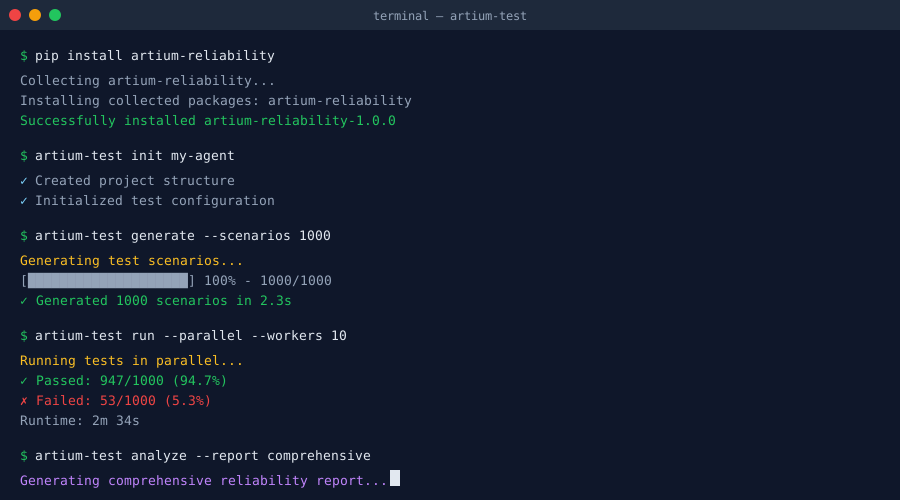
If tests take too long, developers won't run them. Parallel execution and smart caching are essential.
Future Directions
The testing landscape continues to evolve. Promising research areas include:
- Adversarial Testing: AI-generated adversarial test cases
- Formal Verification: Proving properties about agent behavior
- Continuous Learning: Self-improving test suites
- Cross-Agent Testing: Multi-agent system validation
Key Takeaways
Building reliable AI systems requires building smarter testing systems:
- Scenario Generation: Mathematical frameworks guide test coverage
- Parallel Execution: Scale testing without compromising speed
- Comprehensive Analysis: Quantifiable reliability metrics
- Continuous Improvement: Learn from every test run
Production deployments have demonstrated:
- Significant reduction in production incidents
- Faster deployment cycles
- Measurably improved system reliability
This series:
- Introduction to Agentic Reliability
- The Mathematics of Trust
- Building a Testing Framework (this post)
This testing framework was developed through production deployments at Fortune 500 companies, working through Artium AI.