The Octave Lattice
Why a Guitar Fretboard Is Secretly the Integer Grid
Robert Cunningham
AI Engineer & Consultant
I recently added a Notes tool to my guitar app: pick a note, and it lights up every place that note lives on the neck, then draws lines connecting each one to the same note an octave higher. The result is a woven, zig-zagging lattice:
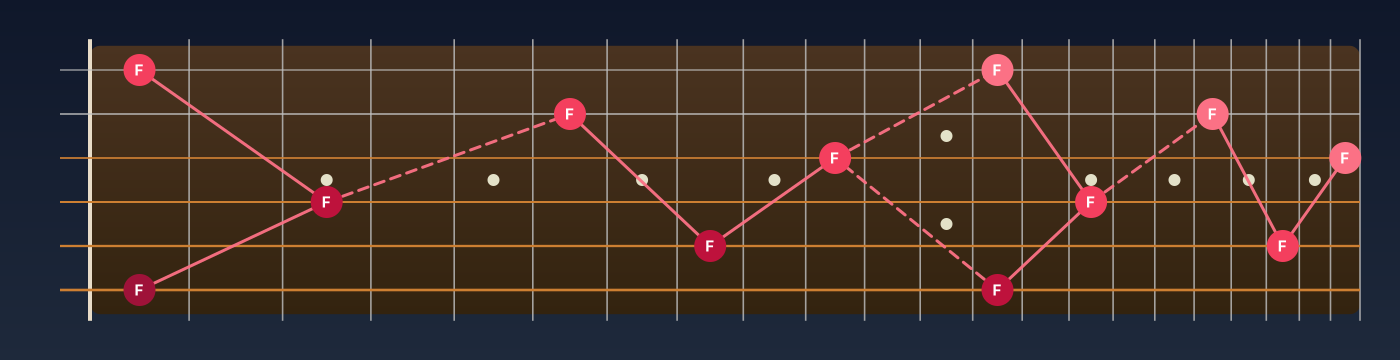
It's pretty. But stare at it long enough and a question forms: what is this thing, structurally? It turns out the answer is one of those small miracles where music and mathematics are quietly the same object. This octave lattice is — up to a change of basis — the integer grid . Let me show you why.
Two shapes
On a guitar in standard tuning, the fastest way to jump up an octave is to skip to a nearby string. There are exactly two compact ways to do it, which I'll name by the compass direction they travel on the neck:
- NE — up 2 strings, and a couple of frets higher.
- NW — up 3 strings, and a couple of frets lower.
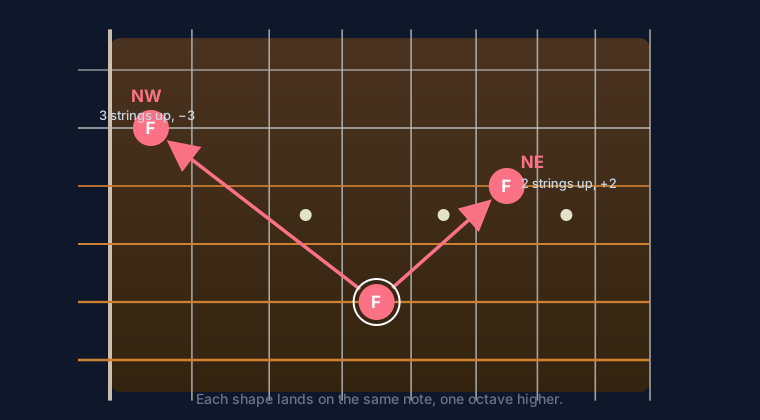
Each shape takes a note to the same note, one octave up. Every line in that first picture is one of these two moves. So let's build a graph out of them.
The model
Let the vertices be all the positions on the neck that sound one pitch class (all the F's). Give each vertex coordinates
where is the string index and is the octave number. This is a faithful coordinate system: each picks out exactly one fret, so reaching every is the same as reaching every note.
Now make the two shapes into directed edges, each pointing one octave up. As displacement vectors in -space they are:
Both raise the octave by one; they differ only in how far they slide across the strings.
The one fact everything hangs on
Stack the two shape-vectors as the columns of a matrix and take its determinant:
Because , the pair is a unimodular basis of . That single fact carries an enormous amount of structure. The linear map sending
is a graph isomorphism from our octave lattice onto the Cayley graph of with the standard generators — that is, onto the ordinary square grid. The whole tangled fretboard picture is the square grid in disguise.
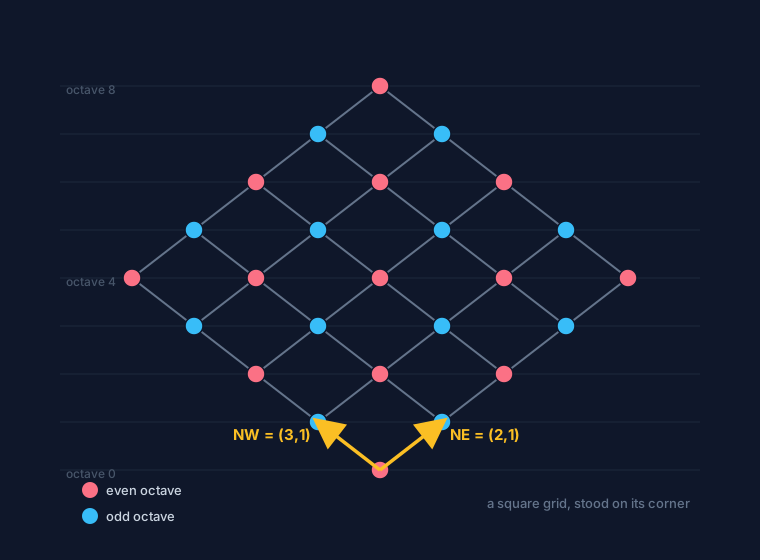
It even explains the zig-zag. Writing a vertex in the new coordinates — where counts NE moves and counts NW moves — the original coordinates come back as
So the octave number is : it is the anti-diagonal of the grid. Lines of constant octave are diagonals, which is exactly why the lattice looks like a diamond weave. The picture is a square grid stood on its corner, with octave as height.
What we get for free
Once you know a graph is the square grid, its properties are just library results:
- Bipartite, with chromatic number . Two-color the notes by the parity of their octave; every edge joins an even octave to an odd one. There are no odd cycles, and the girth is (the smallest loop is one grid square: NE, NW, back-SW, back-SE).
- Planar, genus .
- -regular in the interior: two octaves up (NE, NW) and two octaves down (their mirrors, SW and SE). The real neck is a finite window, so its border vertices simply lose the edges that would run off the fretboard.
- Connected — a single component. You can even see it: NE followed by the downward mirror SE nets a displacement of , a pure one-string sidestep within the same octave. The shapes generate lateral motion, so nothing is stranded.
- Manhattan distances. The fewest octave-shapes between two notes with displacement is the distance in the shape-basis:
A plain octave up is one hop, as it should be. The neck's diameter grows only like (number of octaves) + (notes per octave) — it's small; everything is a few shapes from everything else.
Why you must learn both shapes
Here's my favorite consequence, because it's also practical advice. Take one shape on its own — say NE . By itself it generates only the line : a rank-one sublattice. The NE-only subgraph is therefore a disjoint union of paths — isolated "ladders" climbing the neck that never touch each other. Same for NW.
A single shape can never cover the fretboard, because one vector can't span a plane. You need , and that requires both generators together. Two rank-one forests, unioned, become the full grid. That is the graph-theoretic statement of a very old piece of guitar wisdom: own both octave shapes and the whole neck opens up.
The B-string wrinkle is invisible
Guitarists know the annoying asymmetry: the interval between the G and B strings is a major third, not the perfect fourth between every other pair. It's the one-fret "hiccup" that makes octave shapes shift when they cross those strings.
In this framework, that wrinkle is beautifully powerless. Crossing the G–B boundary changes the fret offset of an edge by one — but it does not change the displacement or . The combinatorial graph never sees it. The wrinkle is purely a distortion of the geometric embedding into fret-space: the lattice stays a perfect, translation-invariant grid, and only the drawing of it bends. The map is warped; the territory is pristine.
Coda
None of this changes a single note you'd play. But I find it clarifying that the thing your fingers are memorizing — "octaves are everywhere, and there are basically two ways to grab them" — is, formally, the statement that two unimodular vectors tile the plane. The fretboard isn't an arbitrary tangle. It's , rotated onto its corner, with a cosmetic dent between the G and B strings.
You can play with the live version — tap any note to see its octave shapes, or turn on the full lattice — in the Notes tab of my guitar app.